
Paid Search Management: What It Covers and What It Costs

Paid search management is the ongoing work of planning, launching and improving the ads that appear when someone searches on Google, so that the clicks you pay for turn into calls, form fills and bookings. It is done in-house or by an outside agency. For a Canadian small business, the real question is not whether to run ads. It is who watches the account every week, and what you get for the monthly fee.
This guide covers how paid search works, what a management service does, how to size a budget, how to measure results and how to choose a provider. We are a Burlington agency that runs Google and Meta ads for trades, clinics and local service businesses, so the examples come from that kind of work.
TL;DR
- Paid search puts your ad at the top of Google results for the searches you choose, and you are charged when someone clicks.
- Management is not setup-and-forget: budgets, bids, keywords, negative keywords, ad copy tests and reporting all need regular attention.
- Judge a campaign by conversions (calls, forms, bookings) and cost per lead, not by clicks or impressions.
- SEO and paid search are different tools that work well together: ads give you speed, SEO builds lasting visibility.
- Our Search Ads plan starts at $399 CAD per month, and our Ads Pro plan starts at $749 CAD per month.
Table of Contents
- How paid search works
- What paid search management includes
- What a good service gives a small business
- How much to budget
- Measuring whether it works
- Running paid search well: common leaks and how to close them
- Paid search and SEO: the same goal, different timing
- How to choose a provider
- Our perspective
- Getting started with us
- FAQ
- Sources
How paid search works
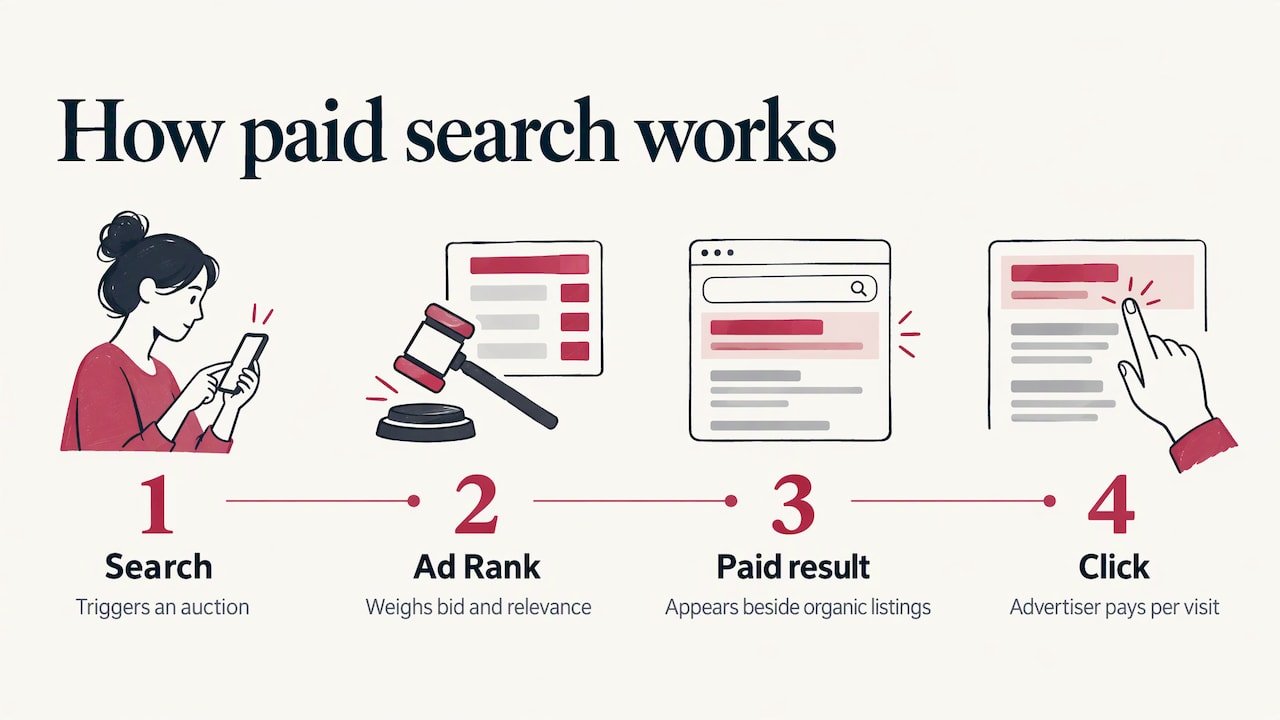
When you search on Google, paid results appear at the top of the results page, next to the organic listings, and the advertiser is charged when someone clicks. You do not pay for being seen. You pay for a visit.
Which ad shows, in which position and at what price is decided in an auction every time a search happens. Google’s Ad Rank weighs your bid together with the usefulness and relevance of your ad and landing page. That is why the highest bidder does not always win, and why a clear ad that points to a focused page can cost less per click than a vague one.
For a local business, this has a practical meaning. A plumber in Hamilton does not need to win every search about plumbing. They need to appear when a homeowner types something like “emergency plumber near me” and the page that opens makes it obvious how to call.
Paid search, PPC and Google Ads: the terms
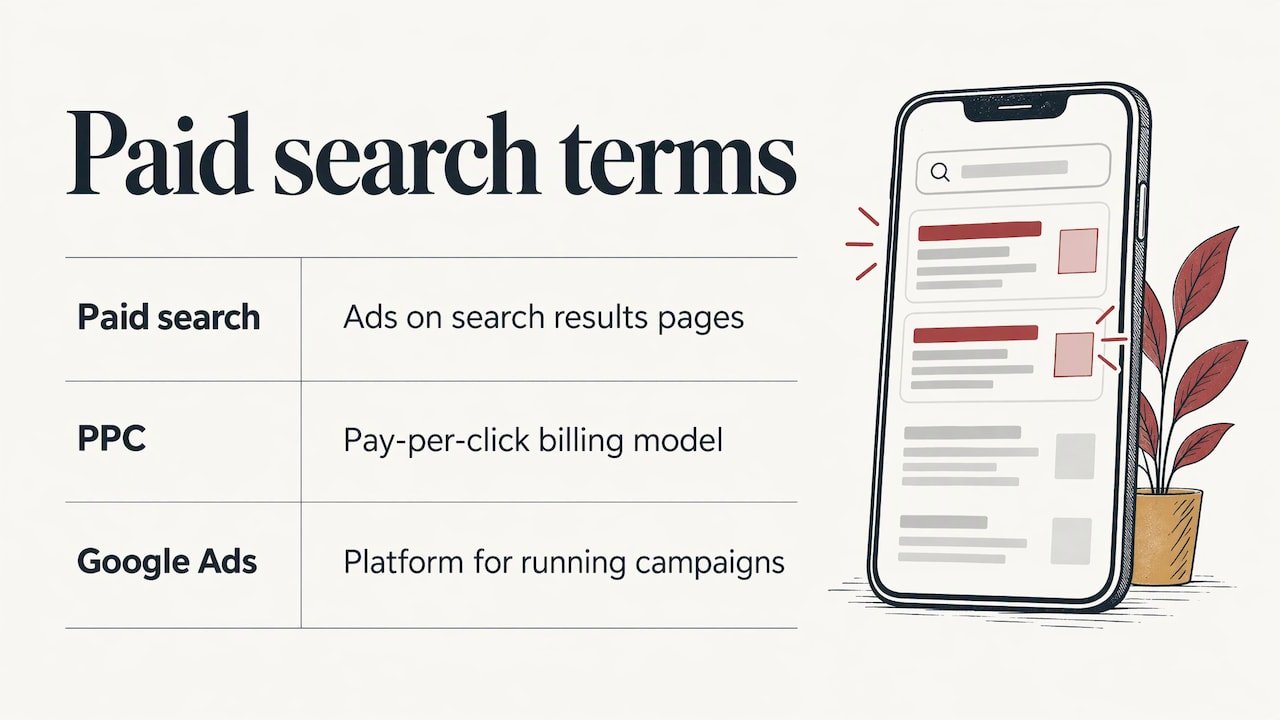
These words are often used as if they were the same. “Paid search” is the category: ads on search engine results pages. “PPC” (pay per click) describes the billing model. “Google Ads” is the platform where most Canadian small businesses run these campaigns. When an agency says it offers PPC management or paid search campaign management, it means running that platform on your behalf.
What paid search management includes
Setting up a campaign is a one-time job. It means choosing a campaign type, refining settings and targeting, setting a budget and bidding strategy, choosing the destination URL and building the ad. Management is everything after launch, and it is where results are won or lost.
Before launch
- Goal and tracking. Decide what counts as a result (a phone call, a quote request, a booking) and make sure each one is recorded. Without this, nothing else can be judged.
- Keyword research. Group the searches your customers use by service and by location, and separate people ready to hire from people only browsing.
- Ad copy and extensions. Write ads that match the search and add the details that earn the click, such as phone number, service area and hours.
- Landing page. Send traffic to a page that matches the ad, loads fast and makes the next step obvious.
After launch
Ongoing work covers budget control, bids, keywords and negatives, ad-copy testing, reporting and competitive intelligence. In practice, that means a weekly routine like this:
- Review the search terms report and add negative keywords, so you stop paying for searches that will never become customers.
- Check that conversions are still being recorded correctly.
- Move budget toward the campaigns and times of day that bring leads.
- Test a new ad headline against the current one.
- Report in plain language: how many leads, what each cost, what changes were made.
The weekly rhythm matters because the auction changes constantly. Competitors adjust, seasons shift and a campaign left alone drifts toward waste.
What a good service gives a small business
Services differ, but a small business should expect the following from any provider:
| What you need | What good management delivers |
|---|---|
| Clear starting point | A review of your goals, service area and current website before any money is spent |
| Accurate measurement | Call tracking and form tracking set up before launch |
| Controlled spending | A daily budget, geographic limits and negative keywords from day one |
| Steady improvement | Regular optimization, not a quarterly check-in |
| Plain reporting | Leads and cost per lead, with the actions taken |
| Somewhere for leads to land | A way to see and follow up on every enquiry |
The last row is where many accounts leak money. If calls go to voicemail or forms sit unanswered for two days, even excellent ads underperform. That is why we pair ad management with lead handling: every client gets our UPMYCRM platform, which gathers leads and communications in one place, and we offer an AI receptionist with missed-call text-back for businesses that cannot always pick up.
How much to budget
There is no official minimum, and the right number depends on what a click costs in your market. The arithmetic is simple: daily budget divided by average cost per click gives you the clicks per day. At a $3 click, $10 a day buys roughly three clicks. If one in ten visitors becomes a lead, that is a lead about every three days. Competitive services such as law, dental, HVAC and roofing often cost much more per click, so the same budget buys fewer visits.
Two habits keep budgets realistic:
- Start from the lead, not the ad spend. Work out what a new customer is worth to you and how many leads it takes to win one. That tells you what a lead can cost before the campaign stops making sense.
- Allow time to learn. A Canadian Google Ads educator recommends planning for at least three months of testing before judging performance, and budgeting for enough daily clicks that the system can collect data. A campaign starved of clicks cannot show you what works.
If you are choosing between a small spread across many services and a larger budget behind one, the focused option usually teaches you more, faster. Start with the service that makes you the most money per job, then expand.
What the management fee covers
The fee for management is separate from what you pay Google for clicks. Our published starting prices:
| Plan | Starting price | Best for |
|---|---|---|
| Search Ads | from $399 CAD per month | Local businesses that want calls and enquiries from Google search |
| Ads Pro | from $749 CAD per month | Businesses that want a broader paid programme |
| Social Ads | from $399 CAD per month | Facebook and Instagram campaigns alongside search |
| Google or Meta Ads Account Audit | from $299 CAD one-off | Businesses already running ads who want a second look |
Measuring whether it works
Clicks are the easiest number to see and the least useful. What counts is what people do next. In Google Ads, the Conversions column shows the conversions recorded across your conversion actions, and related settings such as the attribution model affect how credit is assigned. If you have not defined conversions, you cannot read the account.
For a service business, track these:
- Phone calls from ads, including calls from the ad itself and calls from the landing page.
- Form submissions for quotes and bookings.
- Cost per lead: spend divided by conversions.
- Lead quality: how many of those leads became paying jobs. Cost per acquisition is best read alongside the quality or value of the conversion, and return on ad spend can apply to lead generation too.
A worked example: $1,200 in a month produces 30 leads, so each lead cost $40. If you close 1 in 4 and an average job brings in $900, you won 7 or 8 jobs worth about $6,750. The campaign has paid for itself several times over. Without call tracking and a way to record which lead became a job, you would see only a bill.
That is why we offer Google Analytics 4 and tracking setup from $449 CAD one-off. Good tracking is the foundation of everything else in paid search.
Running paid search well: common leaks and how to close them
Most wasted spend comes from a short list of causes, and each has a standard fix.
- Broad matching with no negatives. Add negative keywords weekly so your ads stop appearing for job seekers, DIY searches and free-service queries.
- Too wide an area. Limit targeting to the neighbourhoods and cities you actually serve, for example Burlington, Oakville and Hamilton.
- A slow or confusing landing page. If the page does not match the ad, visitors leave. Our speed optimization service starts at $399 CAD one-off.
- Broken tracking. A tag that stops firing makes a good campaign look dead. Check conversion recording after every website change.
- No follow-up. Respond fast. A missed call is a lost job, and a text-back within a minute keeps the lead warm.
- Competition pressure. In crowded markets, traffic only continues while the budget does, so the aim is a campaign whose cost per lead is comfortably below the value of the customer. Retargeting can help here by bringing back visitors who did not convert.
Paid search also depends on how your ad looks next to organic results. Ads are labelled, and some searchers skip them, so a strong organic presence and a well-kept Google Business Profile give your ad more credibility when both appear.
Paid search and SEO: the same goal, different timing
They are not the same thing. Paid search is advertising: you pay per click and appear when the campaign is running. SEO earns organic rankings through content, site quality and authority, and it takes longer to build but keeps working without per-click charges.
For a small business, the practical split looks like this:
| Paid search | SEO | |
|---|---|---|
| Speed | Can start bringing enquiries soon after launch | Builds over months |
| Cost model | Pay per click plus management fee | Monthly work, no per-click charge |
| Control | Choose exactly which searches and areas | Rankings are earned, not chosen |
| Best use | Urgent services, new businesses, seasonal offers | Lasting visibility for core services |
A sensible sequence for many local businesses is ads first for immediate enquiries, with Local SEO (from $499 CAD per month) running alongside so visibility grows while ads bring in work. Businesses that serve a wider region can look at National SEO, from $999 CAD per month.
How to choose a provider
When you compare agencies, freelancers and in-house options, ask about things you can verify:
- Who touches your account? One accountable team is better than work passed between a salesperson, a freelancer and an overseas subcontractor.
- What is in the monthly fee? Ask what is included: setup, landing page changes, call tracking, reporting.
- Who owns the account? The Google Ads account should be in your name, with you as admin.
- How are results reported? Look for leads and cost per lead, not impressions.
- Is there a contract lock-in? Understand the notice period before you sign.
- What happens after the click? The provider should care about the website and lead handling, not just the ad.
A local team also knows the market. Our own work in Oakville and Burlington shows how much the competition, the neighbourhoods and the search wording vary even between towns a short drive apart.
Our perspective
Most small business owners come to us after a bad experience: an agency that sent reports full of clicks, a freelancer who disappeared, or a campaign that spent money and produced nothing they could point to.
We think the problem is usually structure, not ads. When a website is built by one company, ads are run by another and tracking is left to a third, nobody owns the result. That is why we do all of it in-house with one team: the website, the ads, the tracking and the lead follow-up.
Our focus is immediate results, meaning calls and enquiries, rather than long-term promises. We set up conversion tracking first, run search ads against the services that make you the most money, and give every client UPMYCRM so each lead is visible and followed up. We have been in business for over 20 years, and that experience shows in how we plan budgets and how we explain the numbers.
If you are going to pay for each click, you should be able to see where each one went.
the author
Getting started with us
If you want a team to run your Google search campaigns, our Search Ads plan starts at $399 CAD per month. If you want a wider programme, Ads Pro starts at $749 CAD per month. Both are managed by the same in-house team that builds websites and sets up tracking, and every client receives UPMYCRM for managing leads.
Already running ads and unsure about the results? Our account audit starts at $299 CAD one-off. To talk through your situation, start at upmysite.ca.
FAQ
What is Google PPC management?
It is the ongoing work of running your Google Ads campaigns: choosing keywords, writing ads, setting budgets and bids, tracking conversions and optimizing based on results. It can be done in-house or by an outside consultant or agency. The aim is more qualified leads for each dollar spent.
Is $100 enough for Google Ads?
You can run a campaign on $100, but it buys few clicks, so it takes longer to learn what works. Divide your budget by your average cost per click to see what it gets you. A narrow service area and one high-value service stretch a small budget the furthest.
Are SEO and paid search the same?
No. Paid search is advertising where you pay per click, and SEO earns organic rankings over time. Many local businesses use ads for quick enquiries while SEO builds lasting visibility.
How long before paid search shows results?
Ads can generate clicks as soon as they are approved and live. Reliable conclusions take longer, because the campaign needs data. Plan on around three months of testing before judging performance.
Sources
- What is PPC: How Does Paid Search Work, Google Ads
- About Ad Rank, Google Ads Help
- What Is PPC Management? WordStream
- Paid Search Management: Tools and Strategy, PaceAds
- 12 Tips for Google Ads with a Low Budget
- How to analyse Google Ads successfully, Google
- How to Measure Success in PPC Campaigns, Search Engine Journal