Facebook Ads for Local Business: A Practical Guide

Facebook ads work for a local business when they are built around one outcome (a call, a booking, a quote request), shown only to people in the area you serve, and tied to tracking that proves which ads produced real enquiries. Most wasted ad money comes from skipping one of those three. We run Facebook and Instagram ads for small businesses in Burlington, Oakville, Hamilton and across the GTA, and our Social Ads plan starts from $399 per month. This guide walks through how to do it properly, whoever ends up running the campaigns.
TL;DR
- Pick one goal per campaign: calls, form leads, bookings or online sales. “Awareness” alone rarely pays the bills for a local trade or clinic.
- Target the neighbourhoods you actually serve, and exclude the ones you don’t.
- Install tracking (Meta Pixel and Conversions API) before spending a dollar, so you can see which ads produce leads.
- Plan to test and adjust. Budget for learning, not for a single perfect ad.
- Speed to respond decides how many leads turn into customers. Capture every lead in one place and answer fast.
Table of Contents
- Do Facebook ads work for local businesses?
- Do Facebook ads work for contractors and trades?
- Start with the goal, then build the campaign
- How to set up Facebook ads for a local business, step by step
- How much do Facebook ads cost for a local business?
- Common mistakes that waste a local ad budget
- Perspective
- Where Upmysite fits
- FAQ
- Sources
Do Facebook ads work for local businesses?
They can, and the reason is simple: Facebook and Instagram (both run through Meta’s ad system) let you put an offer in front of people in a defined area, on a device they check many times a day, at the moment you choose. A roofer in Oakville, a physiotherapy clinic in Hamilton and a boutique in Burlington all use the same tools to reach nearby people who have never heard of them.
What separates a campaign that works from one that doesn’t is rarely the platform. It is the offer, the audience, the landing page and the follow-up. Canada’s business bank, BDC, frames Facebook strategy around the business’s own objectives and where the customer is in the buying journey, rather than around running ads for their own sake (BDC). That is the right starting point.
Facebook ads and Google ads do different jobs
A Google search ad catches someone who is already looking for “emergency plumber” or “dentist near me”. A Facebook ad interrupts someone who was not looking, so it has to earn attention with an offer, a photo or a short video that is relevant to them. That makes Facebook strong for:
- Services people buy on impulse or from a good deal (a seasonal tune-up, a first-visit offer, a free estimate).
- Staying in front of people who visited your website but did not contact you.
- Businesses where the customer needs a nudge, such as clinics, salons, home renovation and retail.
If your customers mostly search when something breaks, Google ads usually catch them first, and the two work well together. Our guide to Google Ads for small businesses covers that side.
Do Facebook ads work for contractors and trades?
Yes, with the right offer. Contractors win on trust and timing, so ads that show finished jobs, a clear service area and an easy way to ask for a quote do better than generic “we’re the best” messages. A few patterns suit trades:
- Before and after photos of real local jobs, with the neighbourhood named.
- A specific, bounded offer, such as a free on-site estimate or a seasonal inspection.
- A short lead form or a call button, because a homeowner scrolling on a phone will not fill in a long page.
The weak point for most trades is not the ad. It is that the lead arrives while the crew is on a roof and nobody answers. That is why we pair ads with lead handling, covered below.
Start with the goal, then build the campaign
BDC describes three broad jobs for Facebook campaigns: raising awareness, informing people who are considering a product or service, and converting leads into sales, and says the stage you pick should shape the campaign (BDC). For a local business, the practical translation is:
| Your situation | Campaign goal | What counts as a win |
|---|---|---|
| New clinic or shop nobody knows yet | Reach people nearby, then retarget those who engage | Page follows, website visits, first bookings |
| Trade wanting more quotes | Leads or calls | Quote requests and phone calls |
| Clinic with open appointment slots | Bookings or enquiries | Booked consultations |
| Retailer with an online store | Sales | Purchases and cost per sale |
Choose the row that matches this quarter’s problem. Running “awareness” when you need bookings is the most common mismatch we see in new accounts.
How to set up Facebook ads for a local business, step by step
BDC points small businesses to Ads Manager, Meta’s ad-building tool, to set up ads, target prospects and measure results (BDC). Here is the routine, with where each step goes wrong and what we take off your hands.
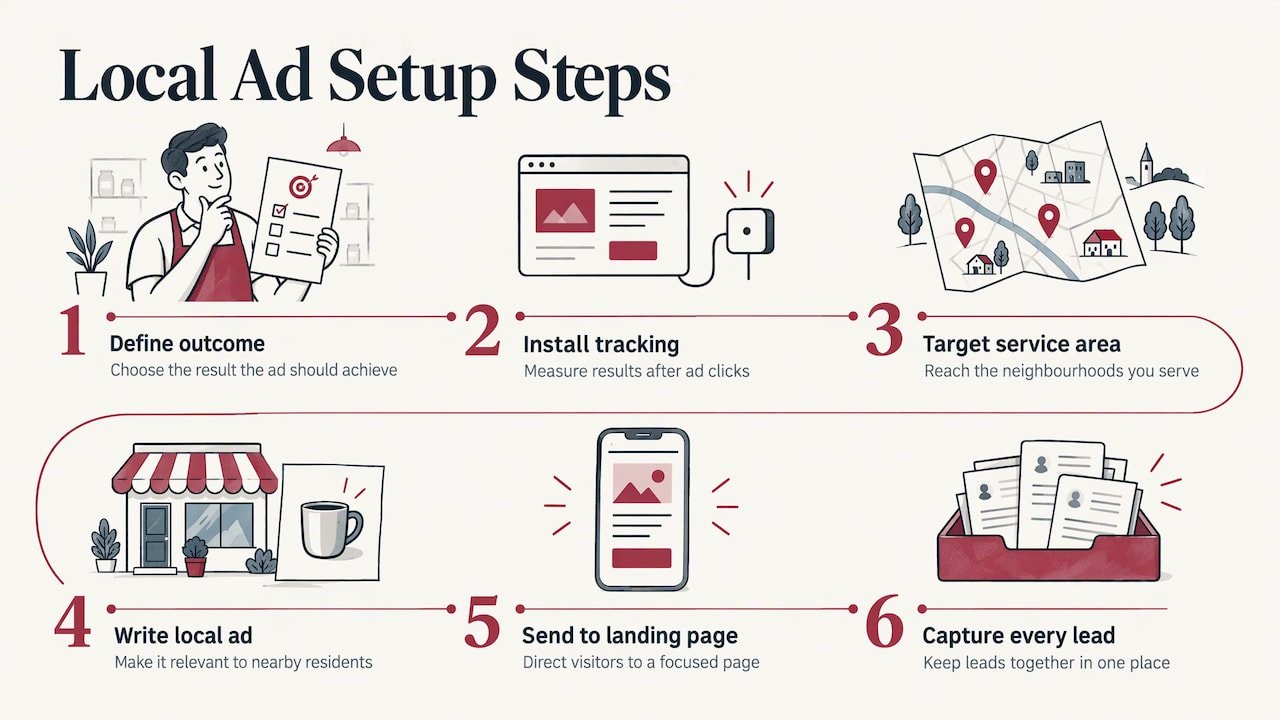
1. Set the outcome and the number that matters
Write down one sentence: “I want 15 quote requests a month from Burlington and Oakville at a cost I can afford.” Work backwards from what a new customer is worth to you. If a job earns you $800 and you close one in four enquiries, you can pay a fair amount per lead.
Where it goes wrong: vague goals such as “get more exposure” lead to ads judged by likes, which don’t pay invoices. Our focus is on immediate results like calls and enquiries, so we begin every account with the lead you want, not the impressions you might get.
2. Install tracking before launch
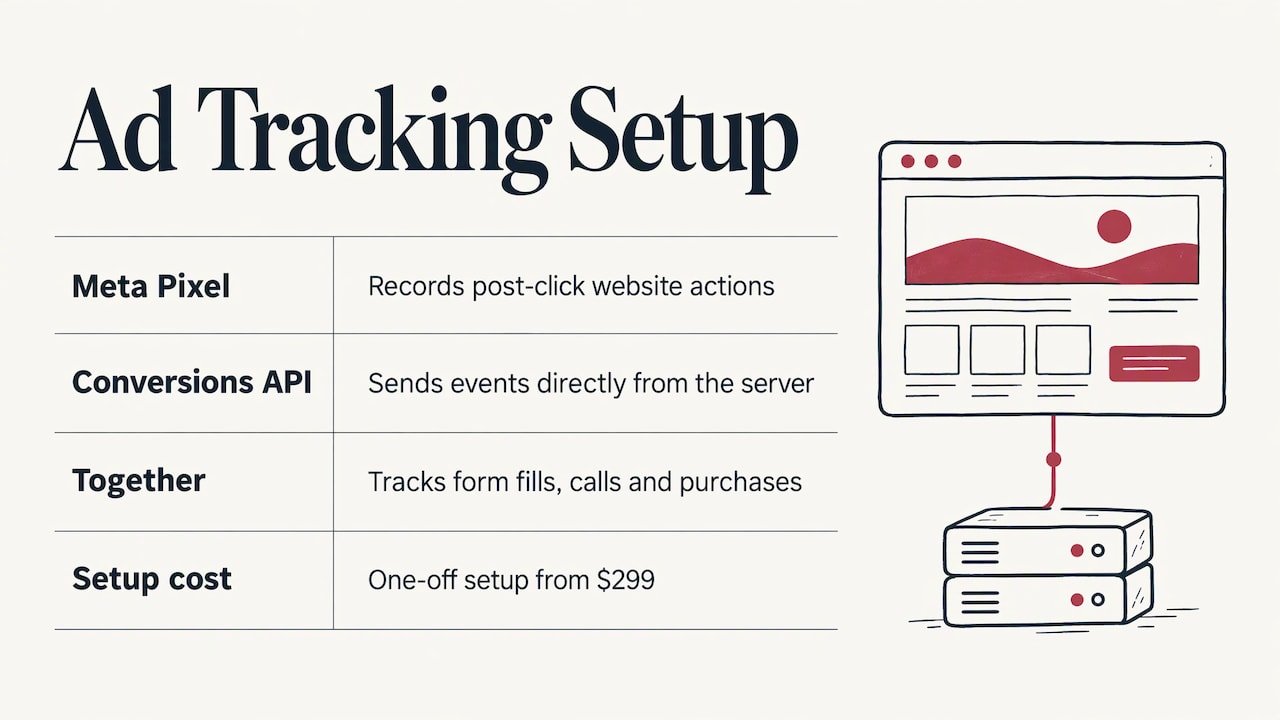
The Meta Pixel is a small piece of code on your website that records what visitors do after clicking an ad. The Conversions API sends the same events to Meta directly from your server, so results are not lost when a browser blocks the pixel. Together they tell Meta (and you) which ads produce form fills, calls and purchases.
Where it goes wrong: many accounts run for months with a broken or missing pixel, so the platform optimizes for clicks instead of leads. Our Meta Pixel and Conversions API setup is a one-off job from $299, and it is done by the same in-house team that runs the ads, so there is no handoff between a web person and an ads person.
3. Target the area you actually serve
Local targeting is the biggest lever you have. In Ads Manager you choose where your audience lives or has recently been, and you can narrow it to specific cities or a distance around your location. For a Burlington HVAC company, that might mean Burlington, Oakville and the east end of Hamilton, and not the whole GTA, because a crew will not drive 90 minutes for a service call.
A few rules of thumb:
- Match the map to your real service area and your travel time, not to your ambition.
- Keep the age and interest filters broad at first. A tight audience in a small town can run out of people quickly and push costs up.
- Use separate campaigns for separate services or cities, so you can see which one pays.
Where it goes wrong: the default settings often reach people outside your area, or the targeting is so narrow the ad stops delivering. We set the area around the neighbourhoods you serve and review it as results come in.
4. Write an ad a neighbour would respond to
Good local ads are plain. They show a real person, a real job or a real storefront, name the area, state one offer and give one next step. Avoid stock photos and avoid cramming three services into one ad.
A simple structure:
- Hook: the problem or the place (“Basement leaking after the rain, Oakville?”).
- Proof: a photo, a short video or a line from a customer.
- Offer: free estimate, first-visit price, booking this week.
- Action: call now, send a message, or request a quote.
Run two or three versions side by side so the data, not opinion, picks the winner.
5. Send people somewhere that converts
The ad earns the click. The landing page earns the lead. It should load quickly on a phone, repeat the offer from the ad, show your phone number and have one short form. Sending traffic to a slow home page with a dozen menu items is how good ads look bad.
If your site is the weak link, we build and fix websites in-house, from a Starter Site from $1,499 through to online stores, and speed optimization is available as a one-off job from $399.
6. Capture every lead in one place
A lead that waits half a day for a reply is often gone. Every Upmysite client receives UPMYCRM, which consolidates leads and communications so enquiries from ads, forms and messages sit in one view instead of scattered across inboxes and apps. If calls are the problem, our AI Receptionist with missed-call text-back is built for the situation where nobody can pick up.
7. Review, test and adjust
BDC advises tracking audience growth, reach, cost per click, cost per action and click-through rate, then experimenting and adjusting toward what works (BDC). For a local lead campaign, two numbers matter most:
- Cost per lead: what you pay for each form, call or message.
- Cost per customer: what you pay for each lead that becomes a paying job.
The second one needs your sales results matched back to the ad, which is where the CRM and tracking earn their place. Cheap leads that never answer the phone are more expensive than fewer, better ones.
How much do Facebook ads cost for a local business?
BDC says a typical Facebook ad costs a few hundred dollars, although many variables affect the cost, and recommends starting by testing what works (BDC). Two separate costs sit behind any campaign:
- The ad spend, paid to Meta. You set a daily or monthly budget, and it is what puts your ad in front of people.
- The management, the work of building, testing and improving campaigns, plus tracking and reporting.
What moves your cost per lead:
- Competition in your area and season. Many renovators bidding for the same homeowners in spring raises prices.
- The offer. A clear, valuable offer gets more responses from the same audience.
- The landing page. A page that converts better lowers every cost downstream.
- Audience size. Too small a service area limits delivery.
- Tracking quality. Good data lets the system find more people like your actual customers.
Our Social Ads plan for Facebook and Instagram starts from $399 per month for management. The ad spend you set for Meta is separate. We would rather you start with a budget you can sustain for a few months, because one week of data rarely tells you enough.
Common mistakes that waste a local ad budget
- Boosting posts instead of building campaigns. A boosted post optimizes for engagement and gives you limited control over goals and targeting.
- No tracking. Without the pixel and Conversions API, you are guessing which ad worked.
- Targeting too wide or too narrow. Either wastes spend or starves delivery.
- One ad, never changed. Audiences tire of the same creative, so refresh and test.
- Slow follow-up. Paying for a lead and answering it the next day is paying for nothing.
- Judging by likes. Likes feel good but don’t book jobs. Judge by calls, forms and revenue.
Perspective
After more than 20 years in business, the pattern we see in small business marketing is that results break down at the handoffs. One company builds the website, another runs the ads, a third looks after tracking, and when leads are weak each one points at the other.
That is why we deliver everything in-house with one team: the website, the Google and Meta ads, the SEO and the tracking. When the ad, the landing page and the pixel are handled by the same people, there is nobody to hand the problem to, and a fix takes days rather than a chain of emails.
We also focus on immediate results, meaning calls and enquiries, instead of long-term promises. For a trade or clinic, a Facebook campaign should be judged on whether the phone rings and the form fills. Because every client gets UPMYCRM, you can see those leads and conversations in one place and tell which ones are turning into work.
Facebook ads are not a magic switch. They reward clear offers, local targeting and steady adjustment, and that is the work we do for businesses in Burlington, Oakville, Hamilton and the rest of the GTA.
the author
Where Upmysite fits
If you would rather have your Facebook and Instagram campaigns handled than learn Ads Manager yourself, our Social Ads plan is a monthly service from $399 per month, delivered by the same team that can build your site, set up your tracking and manage your leads in UPMYCRM. Already running ads that are not producing? Our Google and Meta ads account audit is a one-off from $299.
To talk through your area, your services and a realistic goal, start at upmysite.ca.
FAQ
Can I post business ads on Facebook Marketplace?
Meta’s ad tools can place ads across its apps and sites, and where placements are available you choose them in Ads Manager. For most local service businesses, the News Feed, Stories and Reels placements on Facebook and Instagram are where campaigns are built and tested first, so start there and review results by placement.
How long before Facebook ads bring in leads?
You can see clicks and enquiries within days of launch, but the first weeks are for learning which offer, audience and ad perform best. BDC describes Facebook advertising as an iterative process of testing, tracking and adjusting. Plan for at least a few months of steady improvement before judging the channel.
Do I need a website to run Facebook ads?
It is strongly recommended. A website or landing page gives the ad somewhere to send people, shows your services and phone number, and lets tracking record which ads produce leads. We build sites from $1,499, and the same team can connect them to your ads and to UPMYCRM.
Should a local business use Facebook ads or Google ads?
Often both, because they reach people at different moments. Google catches people actively searching for your service. Facebook and Instagram put your offer in front of nearby people before they search, and let you follow up with those who visited your site. Which one leads depends on whether your customers search first or need a nudge.
What should I measure?
Measure leads (calls, forms, messages), cost per lead and, most importantly, how many leads become paying customers. Reach and click-through rate help diagnose problems, but revenue per ad dollar is the number that tells you whether to spend more.