Contractor SEO Services: What They Include and What to Expect
Contractor SEO services get your business in front of homeowners at the moment they search for a plumber, roofer, electrician or renovator in your area, and turn that visibility into calls and quote requests. For a trade business in Canada, the work that pays is local: a complete Google Business Profile, one real page for each service and town you cover, steady reviews, and tracking that shows which searches ring your phone. At UPMYSITE, our Local SEO plan covers one city and starts from $499 per month, and we deliver it with web, ads and lead tracking under one roof.
TL;DR
- Contractor SEO is mostly local SEO: Google Business Profile, service pages, area pages, reviews and consistent listings.
- Judge it by leads (calls, forms, quote requests), not by rankings or traffic alone.
- Google ranks local results on relevance, distance and prominence, so a complete profile and a steady flow of reviews do a lot of the work.
- A contractor can do the basics alone, but technical setup, tracking and ongoing page work are where a specialist team saves time.
- Our Local SEO plan for one city starts from $499 per month; a Google Business Profile optimization is a one-off from $399.
Table of Contents
- What contractor SEO services actually are
- Why local search matters more than national rankings
- The core work, step by step
- How to tell whether contractor SEO is working
- Is SEO still worth it with AI results and ads in the mix?
- Can you do contractor SEO yourself?
- What to ask before you hire a contractor SEO service
- What contractor SEO costs with us
- Our view: leads first, long promises last
- Get started with local SEO for your trade
- FAQ
- Sources
What contractor SEO services actually are
SEO (search engine optimization) is the work of making your business show up when people search on Google. For contractors, that means two places: the map-style results at the top of the page (the local pack) and the regular website listings underneath.
A good contractor SEO service covers the parts of your online presence that Google reads when it decides who to show:
- Your Google Business Profile, the free listing that powers the map results.
- Your website, with a page for each main service and each town you want calls from.
- Reviews and citations, meaning how many people have rated you and how consistently your name, address and phone number appear across the web.
- Tracking, so you know whether the work produces calls, forms and customers.
A simple field-service SEO plan usually starts with those same pieces: a Google Business Profile, a website, the right keywords and a site that loads quickly. Everything else builds on them.
Why local search matters more than national rankings
A homeowner with a burst pipe in Hamilton does not want the best plumbing website in Canada. They want a licensed plumber close by who answers the phone. Google knows this, and its local results lean on three things. According to Search Engine Journal’s summary of Google’s guidance, local ranking comes down to relevance, distance and prominence: how well your listing matches the search, how far you are from the searcher, and how well known you are, which more reviews and better ratings can improve.
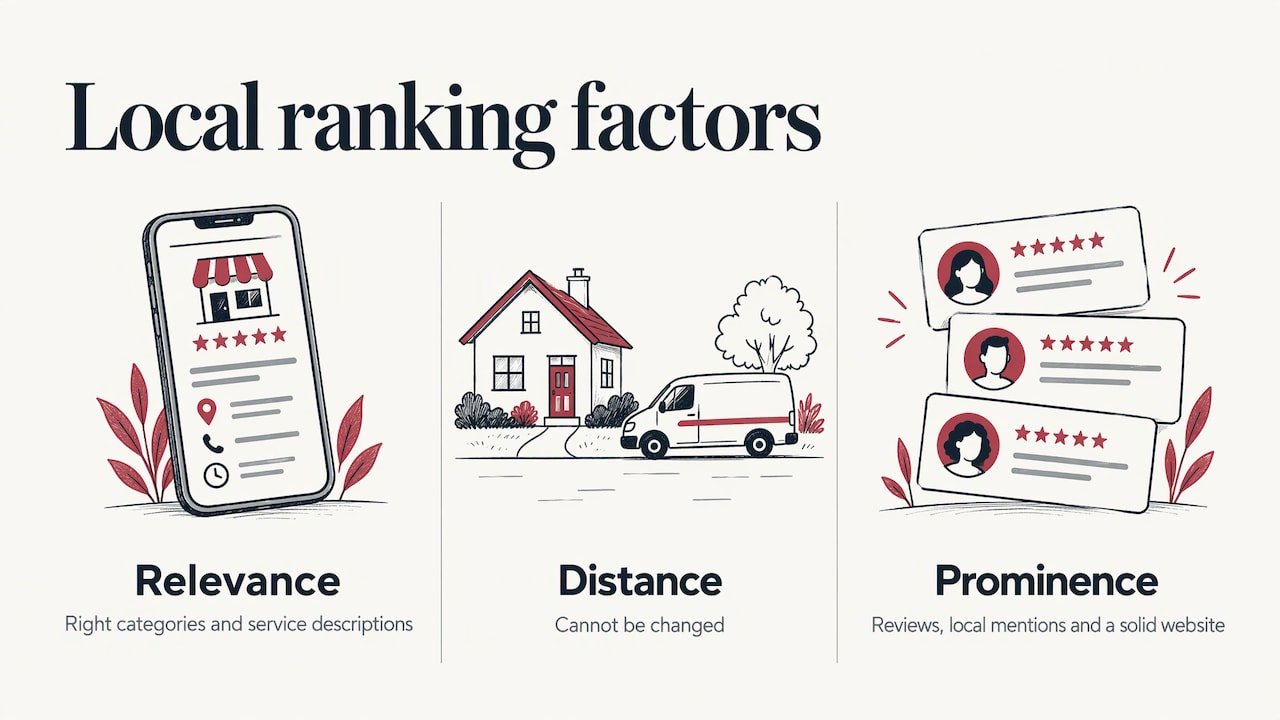
You cannot change distance. You can change the other two. A complete profile with the right categories and service descriptions improves relevance. Reviews, local mentions and a solid website improve prominence.
This is also why a national SEO campaign is rarely the right start for a trade business. If you serve Burlington, Oakville and Hamilton, you want to win those searches, not compete for “contractor” across the country. We cover that difference in more depth in our piece on local SEO versus traditional SEO for Burlington companies.
The core work, step by step
Here is what a contractor SEO routine involves, where each step tends to go wrong, and what we take off your hands.
1. Set up and fully complete your Google Business Profile
This is the highest-value task for most trades. Fill in every field: business name exactly as it appears on your truck and invoices, primary category, secondary categories, service areas, hours, phone number, website, a description of what you do, and real photos of finished jobs.
Where it goes wrong: choosing a vague category, leaving services blank, listing a service area far larger than you really cover, or using a name stuffed with keywords. Any of these can hurt relevance or put the listing at risk of suspension. Jobber notes that a complete, optimized profile can dramatically increase calls and quote requests.
What we do: our Google Business Profile Optimization is a one-off service from $399, and it is the natural first step if your listing is half finished.
2. Build one real page per service
People rarely type just “contractor”. They search for the specific job: bathroom renovation, deck repair, furnace replacement, basement waterproofing. Each money service needs its own page, written about that service, with what is included, how a job runs, photos, pricing guidance where you can give it, and a clear way to call or request a quote.
Where it goes wrong: one “Services” page listing everything in a paragraph each. Google has little to match to a specific search, and neither does a visitor who wants proof you do that exact job.
3. Build one real page per town you serve
A single page listing ten towns will not rank you in each of them. Each town you want calls from needs its own page, written about that town: the types of homes and jobs, nearby projects, and details a local would know. Page titles that carry both the service and the place, such as “Roof Repair in Oakville”, make the match obvious to Google and to the reader.
Where it goes wrong: swapping the town name on copied text. Pages like that add little and are easy to spot. Start with your two or three most important towns, then expand once those pages bring in enquiries.
4. Get reviews on a routine, not by accident
Reviews are the part of prominence you control most directly. Search Engine Land recommends making asking for reviews part of job completion: a QR code linking to your Google review page, the link on invoices, and a thank-you text or email that asks for a rating. It also notes that Google uses review count and rating when ranking local results.
Where it goes wrong: asking only when you remember, or only after the odd great job. The habit matters more than any single request. Reply to every review, positive or not, in a calm, professional tone.
5. Keep your listings consistent
Citations are mentions of your business name, address and phone number on other sites: directories, chambers of commerce, trade associations and map platforms. Search Engine Land suggests listing your business beyond Google, including on directories such as Yelp, Yellow Pages and Bing Places, to reach people who do not search on Google.
Where it goes wrong: three versions of your phone number, an old address, or a business name spelled differently on each site. Fix inconsistencies before adding new listings.
6. Make the site fast and easy to use on a phone
Most trade searches happen on a phone, often in a hurry. A slow page loses the caller before they see your number. Compress images, remove plugins you do not need, and put a tap-to-call button where thumbs reach. We offer a Speed Optimization fix from $399 one-off if your current site drags.
If the site itself is the problem, our Starter Site, Business Site and Online Store builds start from $1,499, $2,499 and $3,499 respectively, one-off.
7. Track what matters
SEO that cannot be measured turns into a monthly argument. The next section covers what to track.
How to tell whether contractor SEO is working
Search Engine Land puts it plainly: the most important SEO metrics for contractors are leads and customers generated, not rankings for their own sake. It suggests using Google Analytics to track lead events such as form starts and form submissions, and using Google Business Profile insights to see local-search views, direction requests, website visits and calls.
A simple monthly scorecard for a contractor:
| What to track | Where to see it | What it tells you |
|---|---|---|
| Phone calls from your profile | Google Business Profile insights | Whether local visibility is turning into contact |
| Direction requests and website clicks | Google Business Profile insights | How many searchers wanted to visit or learn more |
| Quote form submissions | Google Analytics or form tracking | Which pages produce real enquiries |
| New reviews and average rating | Google Business Profile | Whether your review routine is working |
| “How did you find us?” answers | Your own intake call or form | Leads that tracking misses, such as people who call after reading your site |
Jobber’s guide also recommends simply asking new customers how they found you alongside the analytics. It is low-tech and it catches what the software misses.
Where this goes wrong: tracking traffic instead of leads. A page with 500 visits and no calls is worse than one with 50 visits and five quote requests. Set up tracking before the work starts so you have a starting point. Our Analytics & Tracking Setup is a one-off from $449, and every client also gets UPMYCRM, which consolidates leads and communications in one place so you can see where each enquiry came from.
Is SEO still worth it with AI results and ads in the mix?
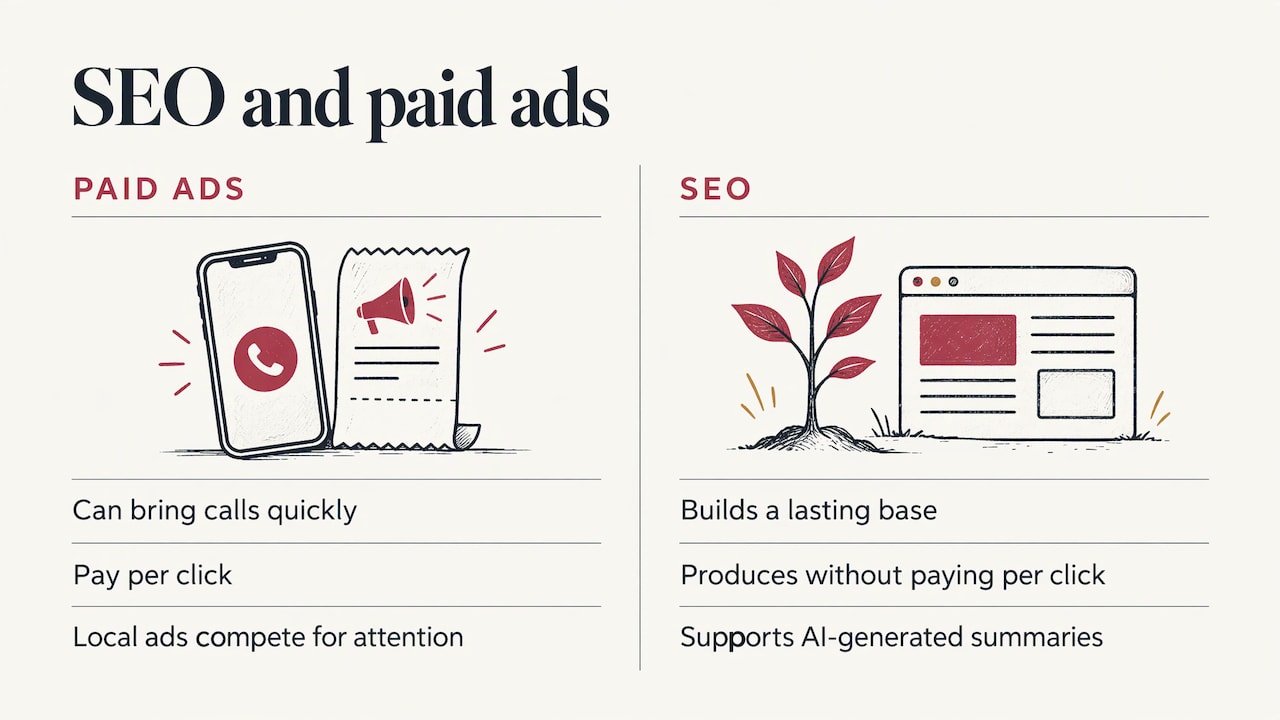
Yes, with a change in emphasis. Google’s results pages now carry more than ten blue links: ads, local packs and AI-generated summaries all compete for attention. Local ads have taken space in many home-service searches, which is one reason many contractors pair SEO with paid search. If you want to see how that works, our Google Ads setup guide for contractors walks through it.
SEO and ads do different jobs. Ads can bring calls quickly while SEO builds a base that keeps producing without paying for each click. A complete profile, specific service pages and a strong review record are also the kind of plain, factual information that AI-driven summaries draw from, so the same work supports both. For a wider look at the full set of channels, see our lead generation guide for contractors.
Can you do contractor SEO yourself?
You can do a good part of it. Claiming and completing your Google Business Profile, asking for reviews and listing yourself in a few directories cost nothing but time. Many contractors start there.
The tasks that eat hours, and where mistakes are costly, are the ones around them:
- Writing and maintaining a page for each service and each town.
- Technical items such as structured data (code that tells Google exactly what your business is and does), site speed and mobile fixes.
- Setting up call and form tracking so results are measurable.
- Keeping all of it current while you are on a job site at 6 a.m.
That is where a team that handles website, SEO, ads and tracking together makes a difference. With one in-house team, there are no handoffs between a web designer, an SEO freelancer and an ads person, each assuming the others did the tracking.
What to ask before you hire a contractor SEO service
Whatever provider you pick, ask for specifics. A useful list of questions to ask an SEO agency before signing covers reporting, contract terms and who does the work. For a trade business, these matter most:
- Who does the work? In-house staff, or a chain of subcontractors?
- What is reported? Calls, form leads and reviews, or only rankings and traffic?
- Which towns and services are covered? Get the list in writing so you know what you pay for.
- Do you own the accounts? Your Google Business Profile, analytics and website should stay yours.
- What is the monthly fee, and what does it include? Fixed, stated prices are easier to compare than quotes that arrive after a call.
Be wary of guaranteed rankings. No one controls Google’s results, and a promise of position one should make you ask how it would be delivered.
What contractor SEO costs with us
Our prices are published, in Canadian dollars:
| Service | Price | Billing |
|---|---|---|
| Local SEO (one city) | from $499 | per month |
| National SEO (region or all of Canada) | from $999 | per month |
| Google Business Profile Optimization | from $399 | one-off |
| Analytics & Tracking Setup | from $449 | one-off |
| Speed Optimization | from $399 | one-off |
| Starter Site | from $1,499 | one-off |
Most trade businesses serving one metro area start with Local SEO. National SEO makes sense for a business that sells or services across a region or the whole country.
Our view: leads first, long promises last
We are a digital marketing agency for small businesses in Canada, working mainly from the Greater Toronto Area, and trades and local services are the businesses we know best. After more than 20 years in business, our view is simple: a contractor does not need a report full of charts. They need the phone to ring.
That is why we build the website, set up the Google Business Profile, run the SEO and manage the ads in-house, with one team. When the person fixing your site speed is the same one setting up your call tracking, nothing gets lost between handoffs, and nobody can point at someone else when a lead goes missing.
Every client also gets UPMYCRM, which brings leads and communications into one place. For a contractor, that means you can see which enquiries came from search, which came from ads, and which are still waiting for a quote. We focus on immediate results, calls and inquiries, rather than long-term promises, and we think SEO should be judged the same way.
If you serve one city, start local. Get the profile right, give each service and town its own page, build a review routine and measure what comes in. That is the work our Local SEO plan is built around.
the author
Get started with local SEO for your trade
If you serve Burlington, Oakville, Hamilton or a nearby city and want more calls from people searching for your trade, our Local SEO plan covers one city from $499 per month. If your listing is the weak spot, the Google Business Profile Optimization from $399 is a one-off place to begin. You can also see everything we offer on our SEO services page.
Missed calls cost contractors jobs too, which is why we also offer an AI Receptionist with missed-call text-back, so a caller who reaches voicemail still gets a reply.
FAQ
How long does contractor SEO take to show results?
It depends on your city, your competition and the state of your current profile and website. Profile fixes and review habits can show movement in local results sooner than new pages do, and new service and town pages usually need more time to build. Ask any provider to show you leads, not just rankings, so you can judge progress month by month.
What is the difference between SEO and Google Ads for a contractor?
Ads appear when you pay for them and stop when the budget stops. SEO builds visibility in the map results and the regular listings that keeps working without a fee for each click. Many contractors use both, ads for speed and SEO for the long run.
Do I need a separate page for every town I serve?
If you want calls from a town, yes, give it its own page written about that town. A single list of towns on one page is unlikely to rank you in each of them. Start with the two or three most important towns and add more as those pages bring in leads.
Is local SEO enough, or do I need national SEO?
If your customers are within driving distance, local SEO is the right fit. National SEO is for businesses that sell or serve across a region or the country. Our Local SEO plan covers one city from $499 per month, and National SEO starts from $999 per month.
Sources
- SEO for Contractors: 6 Strategies and How to Get Started, Jobber
- How to do SEO for contractors (5 steps + examples), Search Engine Land
- Are Relevance, Distance, & Prominence Google Ranking Factors?, Search Engine Journal
- Questions to Ask an SEO Agency Before Signing