AI Phone Answering for Small Businesses in Canada
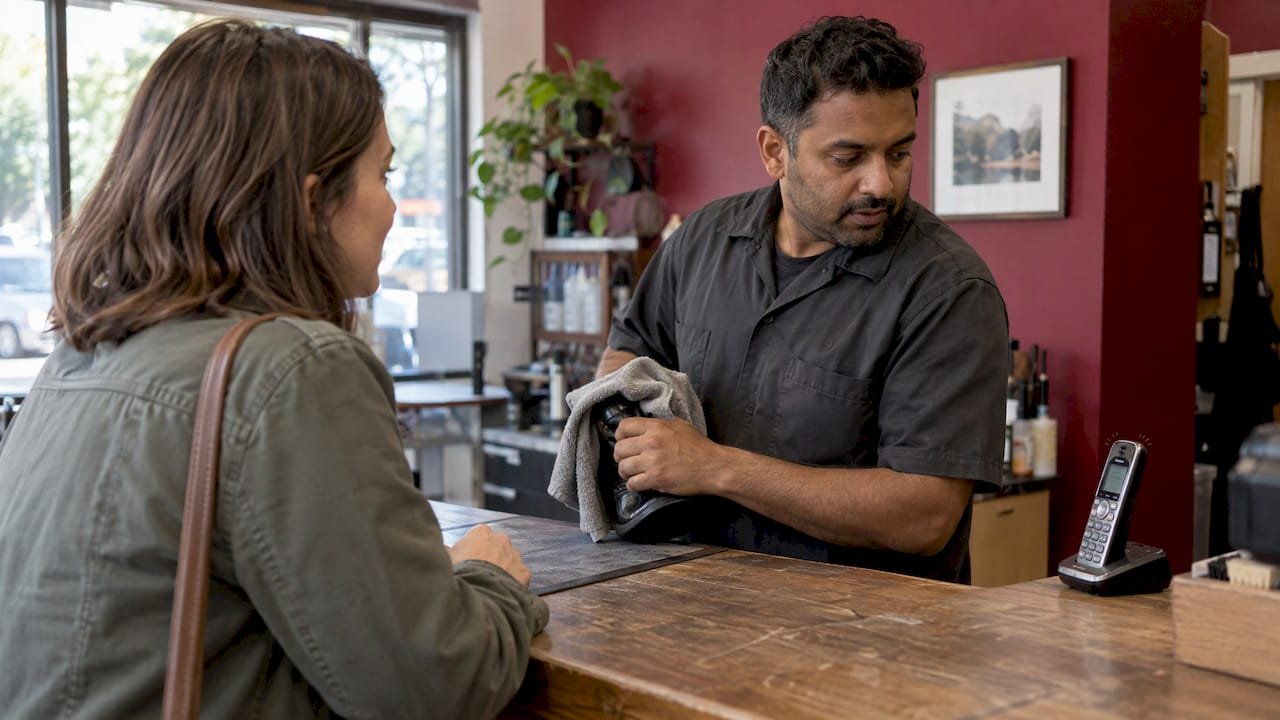
AI phone answering is software that picks up your business line, talks with the caller, answers the routine questions you have set up, books or logs the request and hands the call to a person when it should. For a trades company on a job site, a clinic at full capacity or a shop with one person at the counter, the point is simple: a missed call is usually a lost lead, and a call answered in seconds can become a booked job. The best setup is one where the answering, the follow-up text and the lead record all live in one system run by one team. That is how we build it at UPMYSITE, through our AI Receptionist + Missed-Call Text-Back service.
TL;DR
- An AI phone answering service answers inbound calls, speaks with callers, handles routine questions and bookings, and transfers calls to a person when needed. Voicemail only records a message.
- It suits structured, repeat calls: hours, services, quotes requests, appointment booking. Sensitive or complex conversations should go to your team.
- In Canada, tell callers when a call is recorded, state why, and keep the data only as long as you need it.
- The value is in what happens after the call: a text-back, a logged lead and a clear next step, not just a friendly voice.
- Before you launch, test it with made-up callers and confirm who owns your number and your data.
Table of Contents
- What AI phone answering actually is
- How automated call answering works during a call
- What it handles well, and what stays with your team
- Why the missed call is the real problem
- What to check before you choose a service
- Privacy and call recording in Canada
- From answered call to booked job
- Our perspective
- Setting it up with us
- FAQ
- Sources
What AI phone answering actually is
An AI phone answering service (also sold as an AI receptionist, automated call answering or an AI call answering service) answers your calls with a synthetic voice that holds a real conversation. It is not a phone menu (“press 1 for sales”) and it is not voicemail. Zoom’s description of an AI answering service makes the same distinction: voicemail records a message and waits for a callback, while an AI service can respond and act during the call.
In practice that means the caller says what they need in their own words, and the system:
- Greets them and works out why they are calling.
- Answers the questions you have configured, such as service areas, opening hours or whether you take new patients.
- Collects the details you need: name, number, address, the problem.
- Books a time, sends a text confirmation or passes the call to a person.
You decide which questions it handles and when a call goes to a live team member. That control is the difference between a useful assistant and a frustrating one.
How automated call answering works during a call
Under the hood, a call passes through four layers. Speech-to-text turns the caller’s voice into words. A language model works out what they mean. A business-logic layer decides what to do: answer, route, schedule or escalate. Text-to-speech then speaks the reply. Salesforce’s 2026 guide to AI answering describes the same chain.
You do not need to understand the models. You need to understand the third layer, the rules. Good rules are specific: “If the caller mentions a burst pipe or no heat, transfer to the on-call number. If they ask for a quote, collect the address and the job type, then text them a link to book.” Vague rules produce vague calls.
What it handles well, and what stays with your team
Automated answering works best on structured, repeat calls. The common tasks are answering routine questions, booking appointments, sending SMS confirmations and routing callers to a team member. Complex or sensitive conversations typically stay with people, which is how Salesforce frames it: AI extends your capacity rather than replacing your front desk.
Here is how that looks across the businesses we work with.
| Business | Calls AI answering suits | Calls to send to a person |
|---|---|---|
| Plumbers, HVAC, electricians, landscapers | New-job enquiries, service-area questions, quote requests, booking a site visit | Emergencies you want to triage yourself, repeat customers with a live job |
| Clinics (physio, dental, chiropractic) | Hours, location, new-patient booking, appointment reminders | Clinical questions, urgent symptoms, sensitive personal matters |
| Local retailers | Hours, stock enquiries, pickup and delivery questions | Complaints, large custom orders |
| Local services (salons, cleaners, auto) | Booking, pricing ranges, cancellations | Disputes, special requests |
If a caller describes a medical emergency, they should be directed to 911, not handled by any answering system. Build that into the script for a clinic from day one.
Why the missed call is the real problem
Most small businesses do not lose work because their service is weak. They lose it because the phone rings while they are under a sink, with a patient or serving another customer. The caller does not leave a message; they call the next business on the list. Automated answering closes that gap at any hour, including evenings and weekends when search ads and your Google Business Profile are still sending people to your number.
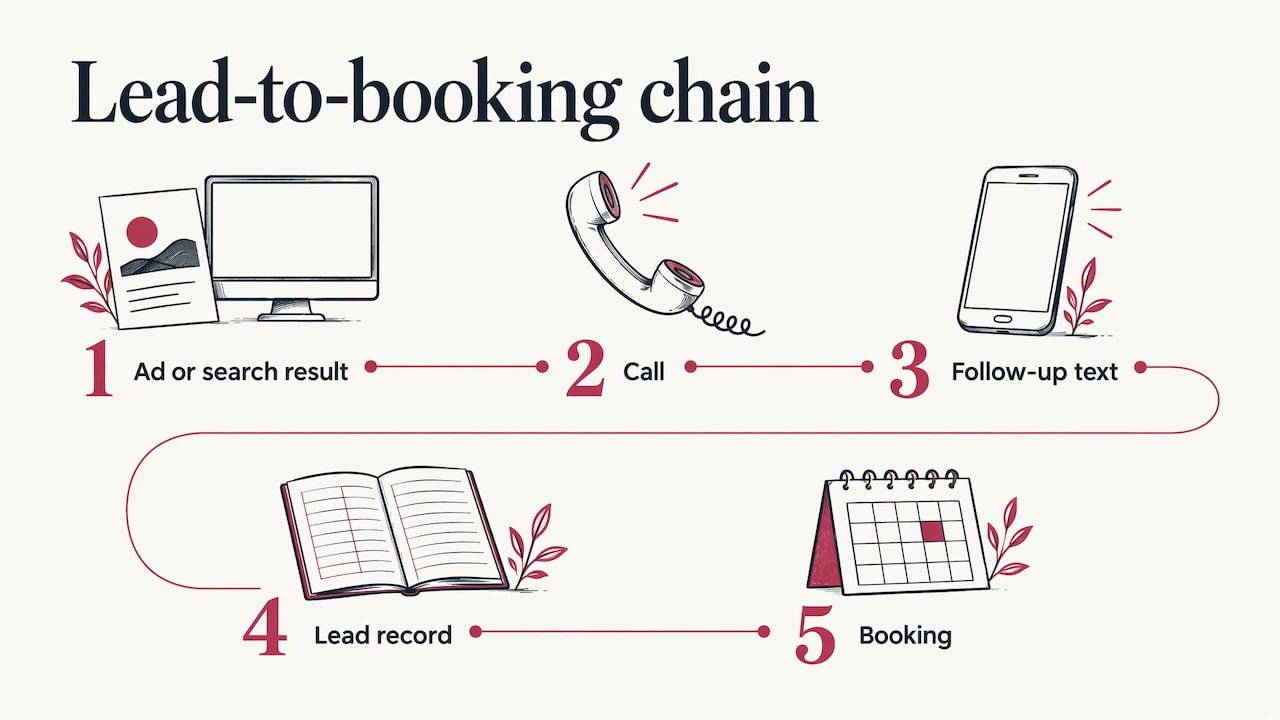
That is why the answering layer should not live alone. If your ads and local search send callers to a phone that goes to a generic service, you pay for the click and lose the lead. We treat the phone as one step in a chain: the ad or search result, the call, the follow-up text, the lead record and the booking.
What to check before you choose a service
Whether you are comparing providers or having us set it up, the same checklist applies. Most of it comes down to control: of the number, of the script and of the data.
Phone number and routing
Confirm that you keep your business number and that calls can be redirected back to your own phone if you stop using the service. A number you do not control is a number you can lose, and that number is on your website, your van and your Google profile.
Calendar, CRM and follow-up
An answering service that books into a calendar nobody checks creates double bookings. Ask which calendar it writes to, whether it confirms by text, and where the caller’s details end up. A call that never becomes a lead record is a call you cannot follow up on or measure. This is where an integrated setup matters: our clients’ leads and communications are consolidated in UPMYCRM, so a call, a text and a form enquiry sit in one place.
Usage and pricing
Pricing models vary. Some plans include a block of AI call minutes per month with overage rates; others offer unlimited calls at a flat fee. Read how minutes are counted, what happens when you exceed them, and whether there is a setup fee. A quiet month and a busy month should both give a bill you can predict.
Language and accents
Many Canadian businesses serve callers in more than one language and with a wide range of accents. Ask how the system performs in the languages your customers use, and test it with them rather than with your own voice.
Test before you go live
Before launch, call the system the way real customers do. Ask the routine questions, ask something it should not know, try to book a time that is already taken, ask to speak to a person, and correct yourself mid-sentence. Use invented names, numbers and addresses for these test calls rather than real customer details. Keep a list of every failure and have it fixed before the number goes live.
Privacy and call recording in Canada
This is the part most guides skip, and it is where a small business can get caught out. If the service records calls or transcribes them, you are collecting personal information.
The Office of the Privacy Commissioner of Canada (OPC) sets out what businesses covered by PIPEDA, the federal private-sector privacy law, need to do. Its guidance on recording customer calls says callers must be told the call is being recorded, the purpose must be stated clearly and narrowly, and consent must be obtained. In most cases, a caller who carries on after hearing the notice can be taken to have consented. If recording is not essential to the service, callers should be offered an alternative unless a legal exception applies. The same guidance calls for safeguards and limited retention.
Turned into practice:
- Open with a clear notice. The greeting should say the call is answered by an automated assistant and may be recorded, and why (for example, to book your appointment and follow up).
- Collect only what you need. A booking needs a name, a number and a time, not a full medical history.
- Decide how long you keep recordings and transcripts, and write it down.
- Know where the data is processed and who at the provider can access it.
The OPC’s principles for generative AI, published on 7 December 2023, point the same way: appropriate purposes, transparency, data minimization and retention schedules. They also recommend synthetic or de-identified information where possible, which is why made-up test calls are the right way to try out a new setup.
If you handle health information, or you are in Quebec or another province with its own private-sector privacy law, check what applies to you with your privacy counsel or the relevant regulator.
Is the AI calling out, or only answering?
Answering inbound calls is different from placing outbound ones. The CRTC, which regulates telecommunications in Canada, began a review of its unsolicited telecommunications rules in a consultation notice dated 11 June 2026. It asks, among other things, whether the rules should explicitly cover synthesized-voice and AI calling technologies. That is a consultation, not a final rule. The same notice explains that the National Do Not Call List and telemarketing rules apply only to telemarketing, while the automatic dialing-announcing device (ADAD) rules also restrict calls where nothing is being sold. If you ever want AI to ring customers back in volume, check the current rules first. A missed-call text-back to someone who just called you is a response to their own contact.
From answered call to booked job
A good call flow is short. Here is a version for a local trades company:
- Call arrives, you are busy. The AI greets the caller, states that it is an automated assistant and that the call may be recorded.
- It qualifies. Job type, address or postal code, urgency, preferred time.
- It acts. It books a visit, or transfers to you if the job is an emergency.
- It follows up. A text confirms the details, and if the caller hung up before finishing, a missed-call text goes out inviting them to reply or book.
- It records. The lead lands in your CRM with the call details, so nobody has to remember.
The measure of success is not how natural the voice sounds. It is how many calls turn into booked appointments and how fast you hear about the ones that did not.
Our perspective
Most businesses we speak to do not have a call-handling problem in isolation. They have a lead problem that shows up at the phone. They pay for a website, ads and a Google Business Profile, and then the call that all of that produces goes to voicemail.
That is why we deliver everything in-house with one team: web design, Google and Meta ads, SEO, Google Business Profile, tracking and the AI receptionist. No handoffs between a web person, an ads person and a phone vendor, each pointing at the other when a call goes missing. When the same team that runs your ads sets up your call answering, we can make sure the number on the ad, the script on the phone and the lead record in UPMYCRM all agree.
We focus on immediate results, calls and inquiries, rather than long-term promises. An AI receptionist with missed-call text-back is one of the quickest ways to put that into practice, because it protects the leads you have already paid to earn.
the author
Setting it up with us
Our AI Receptionist + Missed-Call Text-Back service is part of the same in-house team that builds sites and runs ads for small businesses in Burlington, Oakville, Hamilton and across Canada. Leads and communications are consolidated in UPMYCRM, so you see every enquiry in one place. If you want to understand the wider picture first, our guide to how a virtual receptionist service works explains the options in plain terms.
If your calls come from Google Ads, tracking matters as much as answering: knowing which campaign produced which call tells you where to spend. Our analytics and tracking setup starts from 449 CAD one-off. To talk through what an answering setup would look like for your business, start from upmysite.ca.
FAQ
Can AI answer my business phone calls?
Yes. An AI phone answering service can pick up inbound calls, talk with callers, answer the questions you have configured, book appointments and send text confirmations. When a conversation needs a person, it transfers the call to your team.
What is the difference between AI call answering and voicemail?
Voicemail records a message and waits for you to call back, by which time the caller may have rung a competitor. An AI answering service responds during the call, collects the details and can book or confirm on the spot.
Do I have to tell callers the call is recorded?
If your business is covered by PIPEDA and calls are recorded, yes. The Privacy Commissioner’s guidance says callers should be told, the purpose stated clearly, and consent obtained. Continuing the call after the notice can generally imply consent. Keep recordings only as long as you need them.
Will it replace my receptionist?
It is built to take the routine, repeat calls so your team can focus on the conversations that need a person. Complex and sensitive calls should be set to transfer to your staff.
Does it work for trades, clinics and retail?
Yes, because those businesses share the same pattern: many short calls about hours, services, quotes and bookings, and not enough hands to answer them all. The script and the transfer rules change by trade, which is why they should be written for your business.
Sources
- Recording of Customer Telephone Calls, Office of the Privacy Commissioner of Canada
- Principles for responsible, trustworthy and privacy-protective generative AI, Office of the Privacy Commissioner of Canada
- Compliance and Enforcement Notice of Consultation CRTC 2026-132
- AI Answering Service for Business, Zoom
- 4 Best AI Answering Services in 2026: A Complete Guide, Salesforce